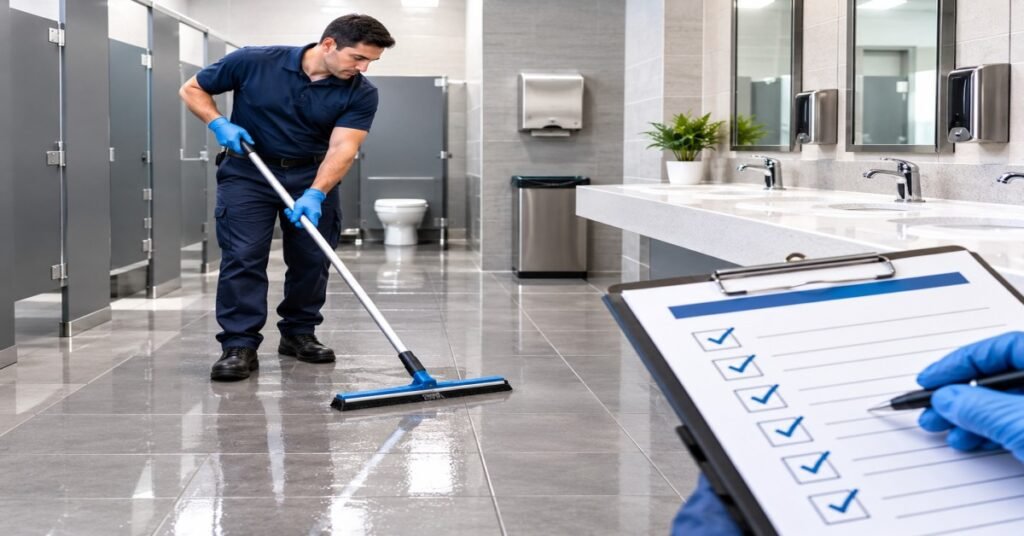
For commercial building owners, medical facility directors, and property managers across New York’s Capital Region, public and employee washrooms represent an immediate operational liability. Whether managing a healthcare facility near New Scotland Avenue, an educational facility in Troy, or a Class-A corporate office on Wolf Road, restroom conditions drive first impressions and regulatory compliance. Utilizing an authoritative commercial restroom cleaning checklist Albany NY facility directors rely on is the primary safeguard against tenant turnover, sanitary code violations, and embarrassing inspection write-ups.
Most commercial restrooms fail internal and municipal sanitary audits not from a lack of custodial effort, but from a complete absence of structured Standard Operating Procedures (SOPs). Custodians often spread pathogens using single-bucket mops, cross-contaminate door hardware with soiled rags, and wipe down chemical solutions before they can kill bacteria. Establishing an exacting commercial restroom cleaning checklist Albany NY operations standard replaces superficial cleaning habits with verifiable, medical-grade hygiene protocols.
At KD Cleaners, our comprehensive commercial cleaning services in Albany NY deliver strict, audit-ready sanitation schedules tailored to regional facilities. Below is the operational framework required to eliminate cross-contamination, protect indoor air quality, and keep your building audit-ready every single day.
📋 Executive Summary: The Audit-Proof Restroom Protocol
- Phase 1 (Staging & Wet Dwell Time): Restock consumables with clean hands before sanitizing surfaces, then apply hospital-grade disinfectants to achieve full chemical dwell time.
- Phase 2 (Touchpoint Sterilization): Eliminate cross-contamination between fixtures and entry points by enforcing four-quadrant, color-coded microfiber procedures.
- Phase 3 (Porcelain Decontamination): Dissolve hidden uric acid buildup behind fixture lips and flush handles to permanently neutralize offensive odors.
- Phase 4 (Dual-Bucket Floor Extraction): Stop spreading contaminated water across grout lines using dual-chamber mopping and mechanical extraction.
- Phase 5 (Audit & Drain Verification): Verify sanitation with quantitative ATP surface testing and weekly P-trap water replenishment.
📑Table of Contents
- Why Commercial Facilities Fail Restroom Sanitation Audits
- Phase 1: Pre-Cleaning Staging, PPE & Disinfectant Wet Dwell Time
- Phase 2: High-Touch Point Disinfection & Microfiber Color Coding
- Phase 3: Fixture Decontamination & Uric Acid Crystallization Control
- Phase 4: Dual-Chamber Mopping & Subfloor Soil Extraction
- Phase 5: Drain Maintenance, Ventilation & ATP Surface Verification
- Daily Restroom Maintenance Checklist vs. Professional Deep Extraction Matrix
- When Daily Maintenance Fails: Restorative Cleaning Services
- Frequently Asked Questions (FAQ)
Why Commercial Facilities Fail Restroom Sanitation Audits
Public commercial washrooms serve as high-density reservoirs for human pathogens, including norovirus, influenza, E. coli, and Methicillin-resistant Staphylococcus aureus (MRSA). When municipal inspectors, third-party corporate auditors, or healthcare accreditation teams evaluate commercial properties, washrooms face the closest scrutiny.
Federal workplace safety directives under OSHA sanitation standards (29 CFR 1910.141) explicitly require all commercial employers to maintain water closets in a clean, fully operable, and sanitary condition. Similarly, New York State public health regulations penalize commercial establishments for broken soap dispensers, lack of hot running water, soiled exhaust registers, and persistent odor problems that signal microbial contamination.
Deploying a systematic commercial restroom cleaning checklist Albany NY operations manual eliminates regulatory vulnerabilities. It converts reactive maintenance into a repeatable standard that ensures your building passes corporate walkthroughs and health department audits without warnings.
Need an Expert Restroom Hygiene Audit in Albany?
Ensure your property satisfies all New York sanitary standards. Contact KD Cleaners today for an on-site commercial restroom audit and customized cleaning plan.
Phase 1: Pre-Cleaning Staging, PPE & Disinfectant Wet Dwell Time
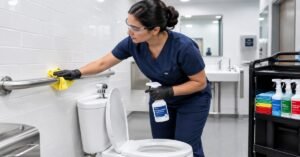
Auditable restroom sanitation begins before any surface scrubbing takes place. Custodial workers must prepare themselves and the work zone to maintain safety and biological containment:
- Zone Security: Deploy bright yellow “Restroom Closed for Cleaning” physical barricades and non-slip caution signage at all entry points to prevent tenant slip-and-fall injuries.
- Technician PPE: Don nitrile medical-grade gloves, eye protection, and non-marking slip-resistant footwear to defend against caustic chemicals and organic bio-fluids.
- Dry Soil Evacuation: Empty sanitary disposal napkin bins, trash receptacles, and floor debris before introducing liquid chemical solutions.
- Consumable Restocking First: Restock paper towels, multi-fold toilet paper, hand soap cartridges, and seat cover liners before cleaning wet surfaces. Handling dry inventory with clean gloves prevents the transfer of wet-surface bacteria onto fresh paper products.
The cornerstone of any reliable commercial restroom cleaning checklist Albany NY routine is respecting chemical dwell times. Apply an EPA-registered hospital-grade disinfectant to all commodes, urinals, washbasins, and flush hardware. Disinfectants must remain visibly wet on the target surface for a full 5 to 10 minutes (per label instructions) to achieve total pathogen deactivation. Wiping chemicals away immediately fails to kill bacteria and invalidates your sanitation process.
Phase 2: High-Touch Point Disinfection & Microfiber Color Coding
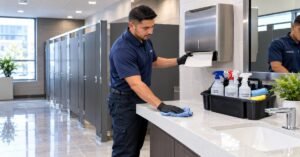
Cross-contamination is the most common reason facilities fail microbial swab audits. When a cleaner uses the same rag to clean toilet rims and sink vanity faucets, pathogens are transferred straight to where building occupants wash their hands.
Your facility’s commercial restroom cleaning checklist Albany NY protocol must mandate an uncompromising four-color microfiber standard:
- Red Microfiber: Restricted solely to high-risk bio-zones, including toilet bowls, urinals, flush levers, and adjacent stall walls.
- Yellow Microfiber: Assigned to secondary contact zones, such as interior stall door latches, partition walls, and sanitary product bins.
- Blue Microfiber: Reserved for low-risk touchpoints, including vanity counter surfaces, soap dispensers, hand dryers, and light switches.
- Green Microfiber: Dedicated exclusively to brightwork metal polishing, glass mirrors, and clean-wall wiping.
Technicians must fold every microfiber cloth into four sections, providing eight distinct cleaning surfaces. Once a quadrant gathers soil, flip the cloth to a clean side to prevent dragging collected contaminants across adjacent surfaces.
Phase 3: Fixture Decontamination & Uric Acid Crystallization Control
Auditors inspect the structural fixtures of a restroom first. Porcelain commodes and urinals generate foul ammonia odors when organic soils dry, crystallize, and decompose inside hidden recesses. Integrating fixture detail work into your daily commercial restroom cleaning checklist Albany NY workflow stops uric salt crystallization before it bonds to surfaces.
Following proper dwell time, technicians should scrub bowls and urinals using an angled bowl swab. Reach up into the interior flush ring channel where mineral deposits and uric scale gather unseen. Detail the flush handles, mounting bolts, porcelain pedestals, and floor-to-wall caulk joints.
Rinse fixtures with clear water to prevent chemical film buildup, then wipe exterior surfaces with a dedicated red microfiber towel. If your facility continues to fight chronic bathroom odors despite daily scrubbing, review our technical guide on commercial bathroom odor removal to understand how uric acid crystals penetrate porous structural materials.
Phase 4: Dual-Chamber Mopping & Subfloor Soil Extraction
Traditional single-bucket string mopping does not clean restroom floors—it redistributes suspended biological slurry into porous cementitious grout lines. As the contaminated mop water evaporates, urine crystals and bacteria remain trapped inside the subfloor.
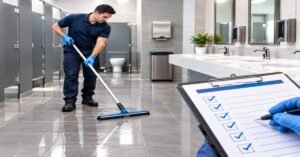
An audit-proof commercial restroom cleaning checklist Albany NY protocol demands either a flat-pad microfiber system with automated chemical dosing or a commercial dual-chamber mopping bucket that isolates dirty rinse water from clean sanitizing solution. Technicians should work from the farthest interior corner backward toward the exit threshold to avoid walking over damp tile.
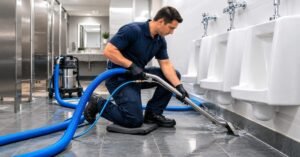
When grout lines begin to blacken and emit foul odors upon exposure to humidity, routine mopping can no longer fix the problem. Facility managers must schedule professional commercial tile and grout cleaning Albany NY treatments. Restorative services utilize self-contained rotary pressure extraction wands heated to 200°F to lift bonded oils, soil, and biological scale that manual mop heads leave behind.
Phase 5: Drain Maintenance, Ventilation & ATP Surface Verification
The final phase of your commercial restroom cleaning checklist Albany NY protocol focuses on unseen environmental factors, specifically indoor air exchange, drainage seals, and objective cleanliness testing.
Inspect all floor drain covers daily. In climate-controlled commercial buildings, low-use floor drain P-traps dry out, allowing dangerous methane and sulfur sewer gases to rise into client areas. Pour at least one gallon of clean water down floor drains weekly to maintain the water trap seal, and clear hair and debris from grates. Wipe exhaust register covers regularly to prevent dust blockages from disrupting building negative air pressure.
Conclude every operational cycle with a quantitative audit. Operations supervisors should use portable ATP (adenosine triphosphate) bioluminescence meters to spot-check door latches, sink faucets, and flush levers. Surface readings under 30 Relative Light Units (RLU) confirm healthcare-grade disinfection, giving building managers documented proof that their facility meets New York State sanitary expectations.
Daily Restroom Maintenance Checklist vs. Professional Deep Extraction Matrix
In-house janitorial staff and outside contractors should use this matrix to distinguish everyday custodial duties from quarterly restorative deep cleaning:
| Audit Inspection Category | Daily Custodial Checklist (In-House) | Quarterly Restorative Extraction (KD Cleaners) | Target Standard |
|---|---|---|---|
| High-Contact Hardware | Wipe with blue/yellow color-coded microfiber towels | Electrostatic broad-spectrum antimicrobial misting | < 30 RLU bioluminescence |
| Porcelain Fixtures | Sub-rim swabbing & 10-minute chemical dwell time | Pressurized steam descaling & wax seal barrier checks | Zero mineral / uric buildup |
| Tile & Grout Flooring | Dual-chamber microfiber mopping with neutral detergent | 200°F high-pressure thermal rotary vacuum extraction | Restored grout color & traction |
| Drain Traps & Vents | Grate wiping & weekly water trap replenishment | Bio-enzymatic line foaming & trap barrier sealing | Zero sewer gas emissions |
When Daily Maintenance Fails: Restorative Cleaning Services
While an internal commercial restroom cleaning checklist Albany NY routine maintains daily surface order, standard custodial crews lack the commercial truck-mounted machinery required to flush decades of embedded soil from deep subfloor layers. Over years of use, microscopic pores in ceramic and quarry tile absorb biological fluids that regular mopping simply cannot reach.
When daily janitorial routines are no longer resolving persistent tenant odor complaints or inspection flags, partnering with KD Cleaners provides the specialized commercial restroom cleaning Albany NY solutions needed to protect your facility’s standing. Our commercial crews utilize industrial-grade bio-enzymatic emulsifiers, self-contained heated extraction wands, and non-porous fluorochemical grout sealants to return high-traffic restrooms to factory-clean conditions.
Frequently Asked Questions
What is the most critical item on a commercial restroom cleaning checklist to avoid failed audits?
Observing disinfectant contact dwell time is the single most critical factor. Disinfectants require 5 to 10 minutes of active wet contact time to penetrate bacterial membranes and kill pathogens. Spraying and wiping right away fails compliance audits because live bacteria remain on the surface.
How often should a commercial restroom cleaning checklist Albany NY routine be completed?
Corporate office buildings should run the full 5-phase protocol once daily during the evening custodial shift, with touchpoint and consumable checks during midday peaks. High-traffic environments, such as medical outpatient clinics and dining establishments, require two full sanitation cycles daily.
What are the most common reasons commercial restrooms fail health inspections in New York?
New York State health and OSHA inspectors frequently flag facilities for absent handwashing supplies (hot water, antibacterial soap, paper towels), blocked mechanical ventilation registers, broken door hardware, and dirty grout lines emitting detectable ammonia vapors. Adhering to our structured protocol prevents each of these violations.
Why do commercial restrooms still smell like urine even after daily cleaning?
Urine contains insoluble uric acid crystals that seep deep into porous grout joints, subfloors, and caulking seams. Traditional string mops simply rehydrate these crystals, feeding ambient bacteria and causing ammonia gas to surge. Removing these deposits requires heated enzymatic digestion and high-pressure rotary extraction.
What quantitative tools do auditors use to evaluate restroom cleanliness?
Inspectors use rapid ATP (adenosine triphosphate) bioluminescence luminometers. A swab is rubbed across high-contact fixtures (such as stall locks, faucets, or flush handles) and read in seconds. Any surface scoring over 30 Relative Light Units (RLU) indicates active biological residue.
Can in-house janitorial teams replace professional restorative extraction?
No. Consistent execution of a commercial restroom cleaning checklist Albany NY routine maintains surface hygiene, but in-house crews lack industrial 200°F extraction equipment capable of pulling embedded subfloor soils. Professional quarterly deep cleanings protect the facility against permanent tile damage and chronic odor penetration.
Ensure Your Facility Passes Every Restroom Audit
📍 Professional Commercial Restroom Solutions Across Albany, Colonie, Latham, Schenectady, Troy & Saratoga County
Stop worrying about unexpected inspection write-ups and poor tenant reviews. Implement the proven commercial restroom cleaning checklist Albany NY system developed by KD Cleaners.
Speak directly with our local commercial sanitation team to schedule an on-site facility audit: