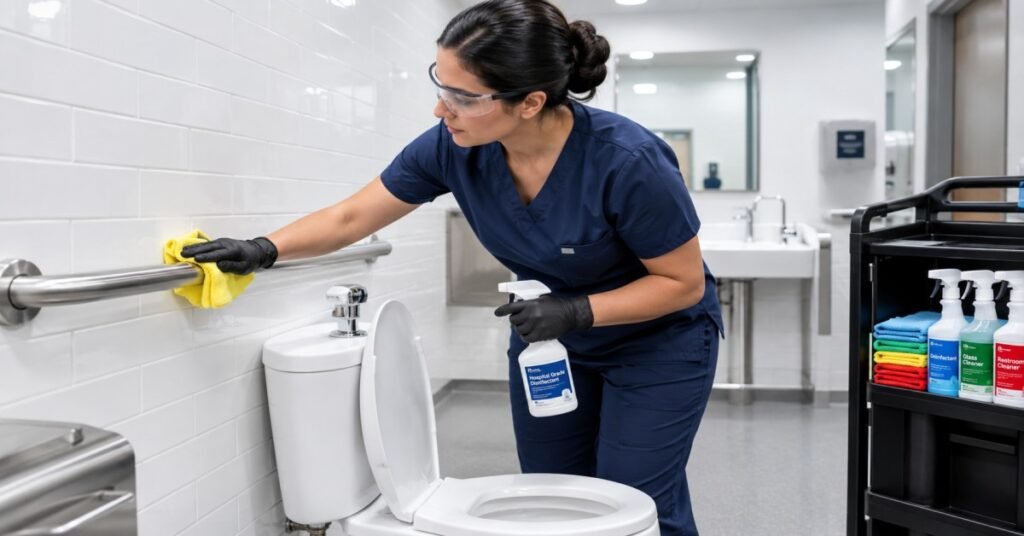
Executing an uncompromising medical restroom cleaning Albany NY protocol is a fundamental regulatory requirement for outpatient clinics, surgical centers, and private practices across the Capital District. Facilities along the New Scotland Avenue healthcare corridor, Hackett Boulevard, and Wolf Road medical plazas face relentless patient foot traffic. In a healthcare environment, a public or staff washroom is not merely a convenience; it is a high-risk transmission zone where opportunistic pathogens can rapidly spread to immunocompromised patients.
Standard office janitorial techniques fail inside clinical settings. When custodial staff use generic multi-surface sprays and damp mops without adhering to verified dwell times, pathogenic reservoirs such as Methicillin-resistant Staphylococcus aureus (MRSA), norovirus, and Clostridioides difficile (C. diff) survive. Contracting a certified medical restroom cleaning Albany NY partner ensures your facility satisfies New York State Department of Health (NYSDOH) codes, preserves your accreditation, and protects your clinical reputation.
At KD Cleaners, our dedicated commercial cleaning services in Albany NY deliver terminal sanitation systems engineered specifically for healthcare providers. Below, we examine the clinical hygiene requirements that separate medical washroom care from commercial custodial routines, outlined through five verified standards for outpatient compliance.
📋 Executive Summary: Healthcare Restroom Compliance at a Glance
- EPA List N Disinfection: Mandates hospital-grade sporicidal and bactericidal chemistries registered for medical-facility surface disinfection.
- Full Chemical Dwell Adherence: Enforces mandatory 3 to 10-minute wet contact times to achieve documented 6-log pathogen reduction.
- Color-Coded Zone Isolation: Prevents pathogenic cross-contamination between biological toilet fixtures and hand-contact vanity areas.
- Aerosolized Bio-Mist Control: Neutralizes viral droplets generated by commercial flush valves across stall walls and grab bars.
- Audit-Proof Logbooks: Why standardized medical restroom cleaning Albany NY documentation protects clinics during unannounced regulatory inspections.
📑Table of Contents
- Why Medical Restroom Cleaning Albany NY Differs from Commercial Janitorial Care
- The 5 Proven Clinic Standards for Medical Restroom Sanitation
- Clinical Restroom Disinfection & Pathogen Inactivation Matrix
- NYSDOH, CDC, and OSHA Regulatory Compliance Parameters
- Integrating Washroom Sanitation into Comprehensive Facility Care
- Frequently Asked Questions (FAQ)
Why Medical Restroom Cleaning Albany NY Differs from Commercial Janitorial Care
Commercial office restrooms are primarily cleaned for cosmetic presentation, odor masking, and basic trash removal. While standard commercial restroom cleaning Albany NY contracts maintain high aesthetic standards for corporate properties, a clinical washroom requires strict microbiological decontamination. Patients visiting Albany healthcare practices often shed viral and bacterial loads onto high-touch surfaces, including flush levers, ADA grab bars, faucet controls, and door handles.
Every time a commercial flushometer operates without a closed lid, it generates a bio-aerosol plume that scatters droplets up to six feet in all directions. According to infection prevention directives from the Centers for Disease Control and Prevention (CDC), environmental surfaces in healthcare environments must undergo structured decontamination using verified broad-spectrum disinfectants to interrupt transmission pathways.
When selecting a qualified medical restroom cleaning Albany NY partner, healthcare administrators must look beyond simple wipe-down services. The sanitation program must incorporate documented Standard Operating Procedures (SOPs) that address pathogen kill claims, chemical dilution ratios, and strict personal protective equipment protocols.
Ensure Your Albany Clinic Passes Sanitary Inspections
Protect patient safety and maintain compliance with CDC and NYSDOH guidelines. Partner with KD Cleaners for specialized clinical restroom sanitation.
The 5 Proven Clinic Standards for Medical Restroom Sanitation
To ensure consistent infection control, healthcare facilities must enforce structured operational procedures. Below are the five proven clinical standards that professional sanitation specialists follow across outpatient clinics:
1. EPA List N Disinfectant Chemistry Selection
Cleaning and disinfecting are distinct processes. Cleaning removes visible bio-burden, while disinfection destroys microscopic vegetative pathogens. When executing medical restroom cleaning Albany NY specialists rely on EPA-registered hospital-grade disinfectants featuring certified kill claims against bloodborne pathogens, respiratory syncytial virus (RSV), and enteric organisms. Formulations are balanced to prevent etching chrome plumbing fixtures or degrading medical-grade epoxy flooring.
2. Strict Wet-Contact Dwell Time Enforcement
The most common error in commercial cleaning is spraying a disinfectant and wiping it off immediately. Surface biocides require specific wet dwell times—typically between 3 and 10 minutes—to penetrate bacterial cell membranes. In rigorous medical restroom cleaning Albany NY operations, dwell time is actively timed and verified, ensuring high-risk organisms like MRSA and norovirus are completely eradicated rather than merely spread across adjacent fixtures.
3. Four-Color Microfiber & Tool Isolation Protocol
Cross-contamination between biological and sanitary zones is a major risk in clinical environments. A proven program implements a strict color-coded microfiber framework:
- Red Microfiber: Restricted exclusively to high-contamination toilet bowls, urinals, and floor areas adjacent to commodes.
- Yellow Microfiber: Designated for secondary biological splash areas, including stall dividers and sanitary disposal units.
- Blue Microfiber: Reserved for handwashing washbasins, vanity countertops, and mirror surfaces.
- Green Microfiber: Utilized exclusively for entryway doors, light switches, and exterior touchpoints.
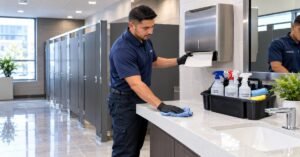
This color discipline ensures that a cloth used on porcelain never contacts a sink faucet. For facility managers standardizing daily custodial shifts, our commercial restroom cleaning checklist Albany NY provides an operational baseline for staff monitoring.
4. Bio-Aerosol Containment & Touchpoint Disinfection
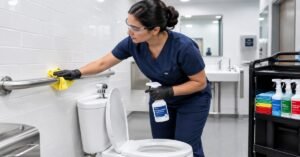
High-pressure commercial flush mechanisms create airborne plumes containing coliform bacteria. As a critical benchmark in medical restroom cleaning Albany NY grab bars, toilet paper dispensers, partition latch mechanisms, and privacy locks are systematically disinfected using broad-spectrum germicides to eliminate settled bio-aerosol residues.
5. Documented Sanitization Logs for NYSDOH Audits
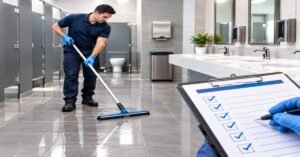
In healthcare, unrecorded sanitation is considered unperformed. Professional crews log every custodial intervention, noting chemical batch numbers, dwell verification times, and technician IDs. Maintaining clear compliance tracking is vital for medical restroom cleaning Albany NY compliance under NYSDOH and Joint Commission accreditation audits.
Clinical Restroom Disinfection & Pathogen Inactivation Matrix
The table below outlines how certified medical restroom cleaning Albany NY protocols address common healthcare-associated pathogens across outpatient facilities. In high-traffic medical practices where patients cycle through washrooms continuously, deploying an on-site restroom day porter service Albany NY ensures that high-touch partition latches, grab bars, and flush levers receive active midday decontamination between evening terminal shifts:
| Target Pathogen | Primary Washroom Reservoir | Required EPA Chemistry | Mandatory Dwell Time |
|---|---|---|---|
| MRSA / Staph Bacteria | ADA grab bars, door levers, toilet seats | Quaternary Ammonium (Hospital Grade) | 3 to 5 Minutes Wet Contact |
| Norovirus (Gastroenteritis) | Flush valves, faucet handles, sink edges | Sodium Hypochlorite / Peracetic Acid | 5 Minutes Wet Contact |
| Clostridioides difficile (Spore) | Porcelain commodes, sub-floor tile joints | Sporicidal Hypochlorite (EPA List K) | 10 Minutes Complete Saturation |
| Hepatitis B & C (Bloodborne) | Sanitary napkin bins, sharps perimeters | EPA Broad-Spectrum Tuberculocidal | 5 to 10 Minutes Wet Contact |
NYSDOH, CDC, and OSHA Regulatory Compliance Parameters
Outpatient clinics operate under multi-layered regulatory oversight. Under OSHA standard 29 CFR 1910.1030, facilities must ensure workers and patients are protected from exposure to bloodborne pathogens and potentially infectious bodily fluids.
When handling bodily fluid spills or sanitary receptacles, technicians must utilize biohazard containment procedures, personal protective equipment (PPE), and puncture-resistant disposal systems. Furthermore, New York Department of Health inspectors examine chemical dilution stations and safety data sheet (SDS) binders during unannounced inspections. Partnering with a dedicated healthcare sanitation provider protects your practice from costly audit citations and compliance fines.
Integrating Washroom Sanitation into Comprehensive Facility Care
While washroom bio-decontamination is critical, it functions as one component of your clinic’s environmental safety strategy. To prevent cross-contamination across clinical suites, washroom disinfection must align with broader medical office cleaning Albany NY procedures that protect patient exam rooms, phlebotomy chairs, and reception waiting areas.
A multi-barrier infection defense requires continuous protocol alignment across the entire physical plant. When specialized clinical washroom sanitation operates alongside coordinated terminal care in procedural suites, healthcare administrators eliminate pathogen vectors before they compromise vulnerable patients or result in regulatory infractions.
Frequently Asked Questions
What makes medical restroom cleaning different from commercial office cleaning?
Commercial office cleaning focuses largely on surface aesthetics, trash removal, and cosmetic cleanliness. In contrast, dedicated medical restroom cleaning Albany NY protocols require hospital-grade, EPA-registered disinfectants, strict chemical dwell times, color-coded microfiber tools to eliminate cross-contamination, and adherence to OSHA bloodborne pathogen standards to protect vulnerable patients.
How often should outpatient medical restrooms be disinfected?
High-traffic outpatient clinics, urgent care centers, and pediatric facilities require terminal disinfection at least once daily after hours, complemented by daytime touchpoint wipe-downs and restocking every 60 to 90 minutes during peak clinical operations.
What chemical dwell time is required for healthcare washrooms?
Standard hospital-grade quaternary disinfectants typically require 3 to 5 minutes of continuous wet contact to neutralize pathogens like MRSA and Influenza. For resilient spore-forming organisms like C. diff, specialized sodium hypochlorite solutions require up to 10 minutes of complete wet contact.
How do your teams prevent cross-contamination between fixtures?
Our technicians follow a strict four-color microfiber protocol. Red cloths are reserved exclusively for commodes and urinals, yellow for secondary biological splash areas, blue for handwashing sinks and vanities, and green for door handles and high-touch hardware. A cloth used on a toilet fixture is never applied to a hand basin.
How do professional cleaning logs protect clinics during health department audits?
Documented sanitation logs record exact service timestamps, chemical batch lot numbers, verified dwell times, and technician signatures. These records provide verifiable proof of regulatory compliance when NYSDOH inspectors conduct unannounced facility health evaluations.
Protect Your Clinic with Certified Healthcare Restroom Sanitation
📍 Clinical Cleaning Solutions in Albany, Colonie, Latham, Troy, Schenectady & Saratoga
Ensure your outpatient facility satisfies strict New York Department of Health sanitary standards. Partner with the specialized medical restroom cleaning Albany NY team at KD Cleaners.
Contact our commercial healthcare sanitation coordinator today for a confidential compliance walkthrough: